 |
LTTng control library C API
|
|
LTTng control library C API
|
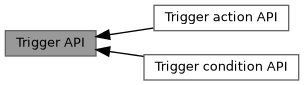
Modules | |
| Trigger condition API | |
| Trigger action API | |
Data Structures | |
| struct | lttng_trigger |
| Trigger (opaque type). More... | |
| struct | lttng_triggers |
| Trigger list (opaque type). More... | |
Enumerations | |
| enum | lttng_trigger_status { LTTNG_TRIGGER_STATUS_OK , LTTNG_TRIGGER_STATUS_ERROR , LTTNG_TRIGGER_STATUS_UNKNOWN , LTTNG_TRIGGER_STATUS_UNSUPPORTED , LTTNG_TRIGGER_STATUS_INVALID , LTTNG_TRIGGER_STATUS_UNSET , LTTNG_TRIGGER_STATUS_PERMISSION_DENIED } |
| Return type of trigger API functions. More... | |
Functions | |
| enum lttng_error_code | lttng_list_triggers (struct lttng_triggers **triggers) |
Sets *triggers to a list of available triggers. | |
| enum lttng_error_code | lttng_register_trigger_with_automatic_name (struct lttng_trigger *trigger) |
Registers the trigger trigger to the session daemon with a generated unique name. | |
| enum lttng_error_code | lttng_register_trigger_with_name (struct lttng_trigger *trigger, const char *name) |
Registers the trigger trigger to the session daemon with the name name. | |
| struct lttng_trigger * | lttng_trigger_create (struct lttng_condition *condition, struct lttng_action *action) |
Creates a trigger to attempt to execute the action action when the condition condition is satisfied. | |
| void | lttng_trigger_destroy (struct lttng_trigger *trigger) |
Destroys the trigger trigger. | |
| struct lttng_action * | lttng_trigger_get_action (struct lttng_trigger *trigger) |
Returns the action of the trigger trigger. | |
| struct lttng_condition * | lttng_trigger_get_condition (struct lttng_trigger *trigger) |
Returns the condition of the trigger trigger. | |
| const struct lttng_action * | lttng_trigger_get_const_action (const struct lttng_trigger *trigger) |
Returns the action of the trigger trigger (const version). | |
| const struct lttng_condition * | lttng_trigger_get_const_condition (const struct lttng_trigger *trigger) |
Returns the condition of the trigger trigger (const version). | |
| enum lttng_trigger_status | lttng_trigger_get_name (const struct lttng_trigger *trigger, const char **name) |
Sets *name to the name of the trigger trigger. | |
| enum lttng_trigger_status | lttng_trigger_get_owner_uid (const struct lttng_trigger *trigger, uid_t *uid) |
Sets *uid to the owner Unix user ID (UID) of the trigger trigger. | |
| enum lttng_trigger_status | lttng_trigger_set_owner_uid (struct lttng_trigger *trigger, uid_t uid) |
Sets the owner Unix user ID (UID) of the trigger trigger to uid. | |
| void | lttng_triggers_destroy (struct lttng_triggers *triggers) |
Destroys the trigger list triggers. | |
| const struct lttng_trigger * | lttng_triggers_get_at_index (const struct lttng_triggers *triggers, unsigned int index) |
Returns the trigger of the trigger list triggers at the index index. | |
| enum lttng_trigger_status | lttng_triggers_get_count (const struct lttng_triggers *triggers, unsigned int *count) |
Sets *count to the number of triggers contained in the trigger list triggers. | |
| int | lttng_unregister_trigger (const struct lttng_trigger *trigger) |
Unregisters the trigger trigger from the session daemon. | |
A trigger associates a condition to an action.
When the condition of a trigger is satisfied, LTTng attempts to execute its action.
A trigger belongs to a session daemon (see lttng-sessiond(8) and Session daemon connection), not to a specific recording session.
To create and register a trigger:
Create the condition and action objects.
If you need LTTng to execute more than one action when the trigger condition is satisfied, then use an action list.
Register the trigger to the connected session daemon with one of:
For a given session daemon, each Unix user has its own, private triggers. Note, however, that the root Unix user may, for the root session daemon:
Add a trigger as another Unix user and remove a trigger which belongs to another Unix user.
Unregister a trigger with lttng_unregister_trigger().
To list the available triggers your Unix user has access to:
Get triggers from the list with lttng_triggers_get_count() and lttng_triggers_get_at_index().
Get the condition and action of a such a trigger with lttng_trigger_get_const_condition() and lttng_trigger_get_const_action().
lttng-concepts(7).lttng-add-trigger(1)lttng-list-triggers(1)lttng-remove-trigger(1) | enum lttng_trigger_status |
|
extern |
Sets *triggers to a list of available triggers.
This function connects to the session daemon to list triggers.
The available triggers are, depending on your Unix user ID (UID):
root) All the triggers of the session daemon to connect to.
| [out] | triggers | On success, this function sets Destroy the returned trigger list with lttng_triggers_destroy(). |
Success
triggers is not NULL.
|
extern |
Registers the trigger trigger to the session daemon with a generated unique name.
This function connects to the session daemon to register trigger.
If lttng_trigger_get_owner_uid() returns LTTNG_TRIGGER_STATUS_UNSET with trigger, then this function sets your current UID as the owner UID for trigger.
| [in] | trigger | Trigger to register to the session daemon (not moved). It's safe to destroy |
Success
trigger is not NULL.trigger with lttng_trigger_create().trigger are valid. The documentation of each trigger condition and action creation function indicates how to build a valid condition/action.root) or the same as the owner UID of trigger.
|
extern |
Registers the trigger trigger to the session daemon with the name name.
This function connects to the session daemon to register trigger.
If lttng_trigger_get_owner_uid() returns LTTNG_TRIGGER_STATUS_UNSET with trigger, then this function sets your current UID as the owner UID for trigger.
| [in] | trigger | Trigger to register to the session daemon (not moved). It's safe to destroy |
| [in] | name | Name of the trigger to register (copied). |
Success
trigger is not NULL.trigger with lttng_trigger_create().trigger are valid. The documentation of each trigger condition and action creation function indicates how to build a valid condition/action.root) or the same as the owner UID of trigger.name is not NULL.name.
|
extern |
Creates a trigger to attempt to execute the action action when the condition condition is satisfied.
This function only creates the trigger object, but doesn't register it to the LTTng session daemon: use lttng_register_trigger_with_automatic_name() or lttng_register_trigger_with_name().
| [in] | condition | Condition of the trigger to create (not moved). |
| [in] | action | Action of the trigger to create (not moved). If you need LTTng to execute more than one action when |
Trigger on success, or NULL on error.
Destroy the returned trigger with lttng_trigger_destroy().
condition is not NULL.action is not NULL.
|
extern |
Destroys the trigger trigger.
| [in] | trigger | Trigger to destroy. May be |
|
extern |
Returns the action of the trigger trigger.
| [in] | trigger | Trigger of which to get the action. |
Action of trigger, or NULL on error.
trigger owns the returned action.
The returned action remains valid as long as trigger exists.
trigger is not NULL.
|
extern |
Returns the condition of the trigger trigger.
| [in] | trigger | Trigger of which to get the condition. |
Condition of trigger, or NULL on error.
trigger owns the returned condition.
The returned condition remains valid as long as trigger exists.
trigger is not NULL.
|
extern |
Returns the action of the trigger trigger (const version).
| [in] | trigger | Trigger of which to get the action. |
Action of trigger, or NULL on error.
trigger owns the returned action.
The returned action remains valid as long as trigger exists.
trigger is not NULL.
|
extern |
Returns the condition of the trigger trigger (const version).
| [in] | trigger | Trigger of which to get the condition. |
Condition of trigger, or NULL on error.
trigger owns the returned condition.
The returned condition remains valid as long as trigger exists.
trigger is not NULL.
|
extern |
Sets *name to the name of the trigger trigger.
| [in] | trigger | Trigger of which to get the name. |
| [out] | name | On success, this function sets
|
| LTTNG_TRIGGER_STATUS_OK | Success. |
| LTTNG_TRIGGER_STATUS_UNSET | trigger has no name. |
| LTTNG_TRIGGER_STATUS_INVALID | Unsatisfied precondition. |
trigger is not NULL.name is not NULL.
|
extern |
Sets *uid to the owner Unix user ID (UID) of the trigger trigger.
| [in] | trigger | Trigger of which to get the owner UID. |
| [out] | uid | On success, this function sets *uid to the owner UID of trigger. |
| LTTNG_TRIGGER_STATUS_OK | Success. |
| LTTNG_TRIGGER_STATUS_UNSET | trigger has no specific owner UID. |
| LTTNG_TRIGGER_STATUS_INVALID | Unsatisfied precondition. |
trigger is not NULL.uid is not NULL.
|
extern |
Sets the owner Unix user ID (UID) of the trigger trigger to uid.
This function can only succeed if your Unix user is root and you're connecting to a root LTTng session daemon.
When you register trigger with lttng_register_trigger_with_name() or lttng_register_trigger_with_automatic_name() after calling this function, it's equivalent to some process of Unix user uid, part of the tracing group, doing it.
| [in] | trigger | Trigger of which to set the owner UID to uid. |
| [in] | uid | Owner UID of trigger. |
| LTTNG_TRIGGER_STATUS_OK | Success. |
| LTTNG_TRIGGER_STATUS_PERMISSION_DENIED | Permission denied. |
| LTTNG_TRIGGER_STATUS_INVALID | Unsatisfied precondition. |
root (UID 0).trigger is not NULL.trigger isn't registered yet (you didn't call lttng_register_trigger_with_name() or lttng_register_trigger_with_automatic_name() with it).
|
extern |
Destroys the trigger list triggers.
| [in] | triggers | Trigger list to destroy. May be |
|
extern |
Returns the trigger of the trigger list triggers at the index index.
| [in] | triggers | Trigger list of which to get the trigger at the index index. |
| [in] | index | Index of the trigger to get from triggers. |
Trigger of the triggers triggers at the index index, or NULL on error.
triggers owns the returned trigger.
The returned trigger remains valid as long as triggers exists.
triggers is not NULL.index is less than the number of triggers (as returned by lttng_triggers_get_count()) of triggers.
|
extern |
Sets *count to the number of triggers contained in the trigger list triggers.
| [in] | triggers | Trigger list of which to get the number of contained triggers. |
| [out] | count | On success, this function sets *count to the number of triggers in triggers. |
| LTTNG_TRIGGER_STATUS_OK | Success. |
| LTTNG_TRIGGER_STATUS_INVALID | Unsatisfied precondition. |
triggers is not NULL.count is not NULL.
|
extern |
Unregisters the trigger trigger from the session daemon.
This function connects to the session daemon to unregister trigger.
| [in] | trigger | Trigger to unregister from the session daemon (not moved). It's safe to destroy |
Success
trigger is not NULL.trigger is currently registered to the session daemon to connect to.root) or the same as the owner UID of trigger. 1.9.8
1.9.8 